


🔥Hot Sale 49% off🌟🪤High-Power Ultrasonic Pest Repeller
🔥Hot Sale 49% off🌟🪤High-Power Ultrasonic Pest Repeller
🔊 Advanced Ultrasonic Technology
🧠 Multi-Signal Pest Disruption System
🐭 Multi-Mode Operation
🌙 Smart LED Night Function
🌿 Safe & Eco-Friendly Solution
BUNDLE & SAVE
Couldn't load pickup availability

🔥Hot Sale 49% off🌟🪤High-Power Ultrasonic Pest Repeller
FEATURES
HIGH-POWER ULTRASONIC PEST REPELLER - Experience unparalleled pest control with our high-power ultrasonic repeller. Designed to emit dynamic waves, it effectively safeguards your entire home without harmful chemicals.

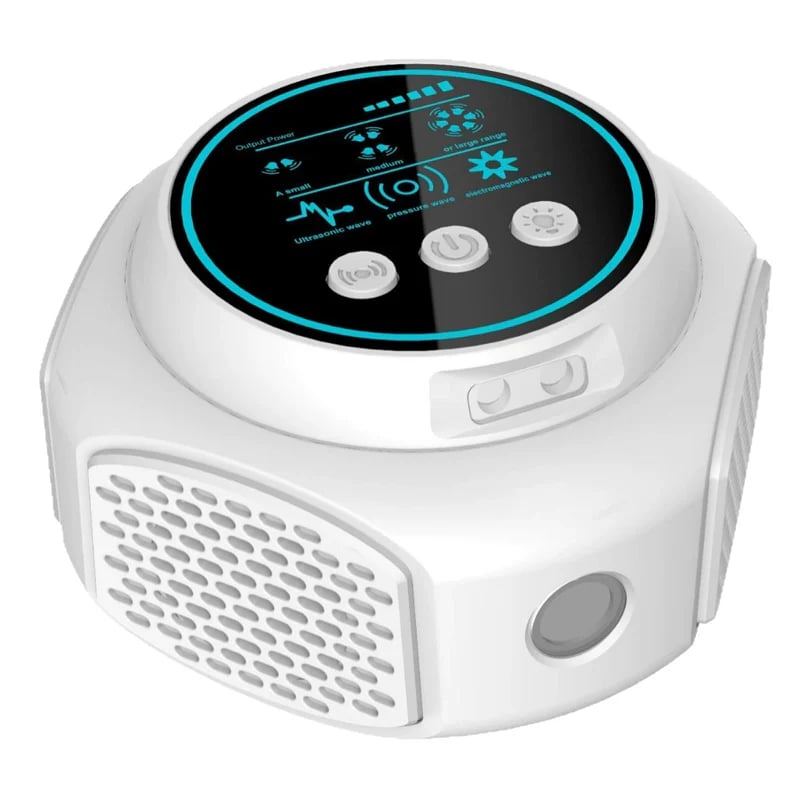
DYNAMIC FREQUENCY WAVE TECHNOLOGY - Utilizing a sophisticated blend of ultrasonic, pressure, and electromagnetic waves, the repeller constantly shifts frequencies to ensure pests never adapt to the environment.

INSTANT PEST-FREE ENVIRONMENT - Transform your living space into a fortress. The continuous emission of variable electromagnetic and pressure waves drives away rodents and insects quickly and effectively.

INTUITIVE SMART TOUCH DISPLAY - Navigate through multiple frequency modes effortlessly using the sleek, responsive touch screen. The clear digital interface ensures you always know the active protection status.

ADVANCED TRIPLE SPEAKER SYSTEM - Equipped with three strategically placed acoustic grills, this device delivers a powerful, multi-directional blast of ultrasonic waves, leaving no blind spots in your room.

SPEC
Material: ABS Plastic, Electronic Components
Color: Black, White
Size: 150 x 60 mm (5.9 x 2.4 inches)
Rated Voltage: 220V
Rated Power: 6-8W
Output Frequency: 20kHz - 45kHz
Plug Type: US Plug, EU Plug, UK Plug, AU Plug
Package Includes: 1 * High-Power Ultrasonic Pest Repeller
NOTES
Ultrasonic waves do not travel through walls. For best results, place one unit in each room where pest activity is suspected.
The device may take 2-4 weeks to show significant results as pests will gradually be driven away. Please be patient during this period.
Keep the device away from carpeted areas, curtains, and other sound-absorbing materials to ensure maximum effectiveness of the ultrasonic waves.


FAQ
Q1: How does the ultrasonic insecticide device work? Why is it effective against mice but harmless to humans?
Q1: How does the ultrasonic insecticide device work? Why is it effective against mice but harmless to humans?
A: This product generates high-frequency sound waves through an internal electronic oscillation circuit, typically ranging from 20 kHz to 65 kHz. This frequency is far beyond the upper limit that the human ear can perceive (approximately 20 kHz), so humans cannot hear its sound. These high-frequency sound waves are said to stimulate the auditory and nervous systems of pests, disrupting their normal behavioral patterns such as feeding, communication, and nest-building, thereby causing discomfort and prompting them to leave the covered area.
Theoretically, mice and many insects are highly sensitive to this high-frequency sound wave. They use similar frequencies in their natural environment for communication or to sense danger. The ultrasonic pest repellent emits sound waves with specific rhythms and frequency variations, attempting to break the pests' adaptation to a single continuous sound, making them intolerant and choosing to leave. The frequency range of different products can range from 30kHz to 95kHz, covering the sensitive frequency bands of various pests.
Q2: Can it really kill mice or insects?
Q2: Can it really kill mice or insects?
A: No. The working principle of the ultrasonic pest repellent is to drive away pests rather than kill them. It creates an environment that is "very unfriendly to sound" to stimulate the pests, making them uncomfortable and causing them to leave on their own. It does not kill the pests directly like poison bait or traps do.
Q3: Can ultrasonic waves pass through walls and floors? Can they cover the entire house?
Q3: Can ultrasonic waves pass through walls and floors? Can they cover the entire house?
A: It cannot penetrate walls, floors, ceilings or furniture. Ultrasound is essentially a high-frequency mechanical wave, and its propagation in the air is greatly affected by obstacles. Hard surfaces (such as concrete walls and furniture) will reflect or block the ultrasound, while soft surfaces (such as carpets, curtains, sofas, and soft cushions) will absorb the energy of the ultrasound, resulting in a significant reduction in the effective range.
Q4: Do I have pets (such as cats, dogs, birds, or fish), and will it affect them?
Q4: Do I have pets (such as cats, dogs, birds, or fish), and will it affect them?
A: Usually not. The upper limit of hearing frequency that cats, dogs, birds and fish can perceive is typically much lower than the operating frequency of ultrasonic devices (approximately 25-65 kHz). Therefore, for generally healthy cats, dogs and birds, these ultrasonic sounds are inaudible and do not cause stress or discomfort.
Q5: Does it cause any interference with household appliances, WiFi, TV, or pacemakers?
Q5: Does it cause any interference with household appliances, WiFi, TV, or pacemakers?
A: For ordinary household electronic products, since the ultrasonic frequency is much higher than the electrical noise of common household appliances, these devices themselves adopt independent electronic oscillation and sound generation systems. They generally do not cause measurable interference to daily appliances such as televisions, WiFi, microwave ovens, and refrigerators.
The most-liked Facebook user reviews
-

3 Days ago
Been using this for about 3 weeks and I'm genuinely impressed. 🙌 Had mice scratching in my attic and garage – now it's completely quiet. Easy to use, just plug in and forget. Best $20 I've spent on pest control.
5.2k
139 Comments
LikeCommentShare -

2 Days ago
Noticed fewer ants in the kitchen and no more cockroach sightings since I plugged this in. 🐜 It's completely silent to me, but pests seem to hate it. Works in my basement too. Definitely recommending to my neighbors.
3.3k
108 Comments
LikeCommentShare -

1 Days ago
Put two of these in my barn and one in the RV. 🚐 No more mouse droppings on the seats or chewed wires. They've been running for months without any issues. Super affordable compared to an exterminator. Highly recommend!
2.3k
88 Comments
LikeCommentShare


